Skip navigation
Growth Strategies and Growth Marketing

Playbook for Your Business

Kasvustrategiat_ja_kasvumarkkinointi alasivu

The Playbook is a marketing and sales plan built on the foundation of your company's growth strategy, designed to help you achieve your set goals. It ties together everything from defining buyer personas and buyer journeys to content strategy, marketing communications, and goal setting.

In today's Playbook, AI and agents play a central role. The Playbook also creates a model for leveraging them in the way that makes most sense for your specific business.

ostopolku-workshop

Playbook in a Nutshell

  1. Roadmap to successful marketing and sales

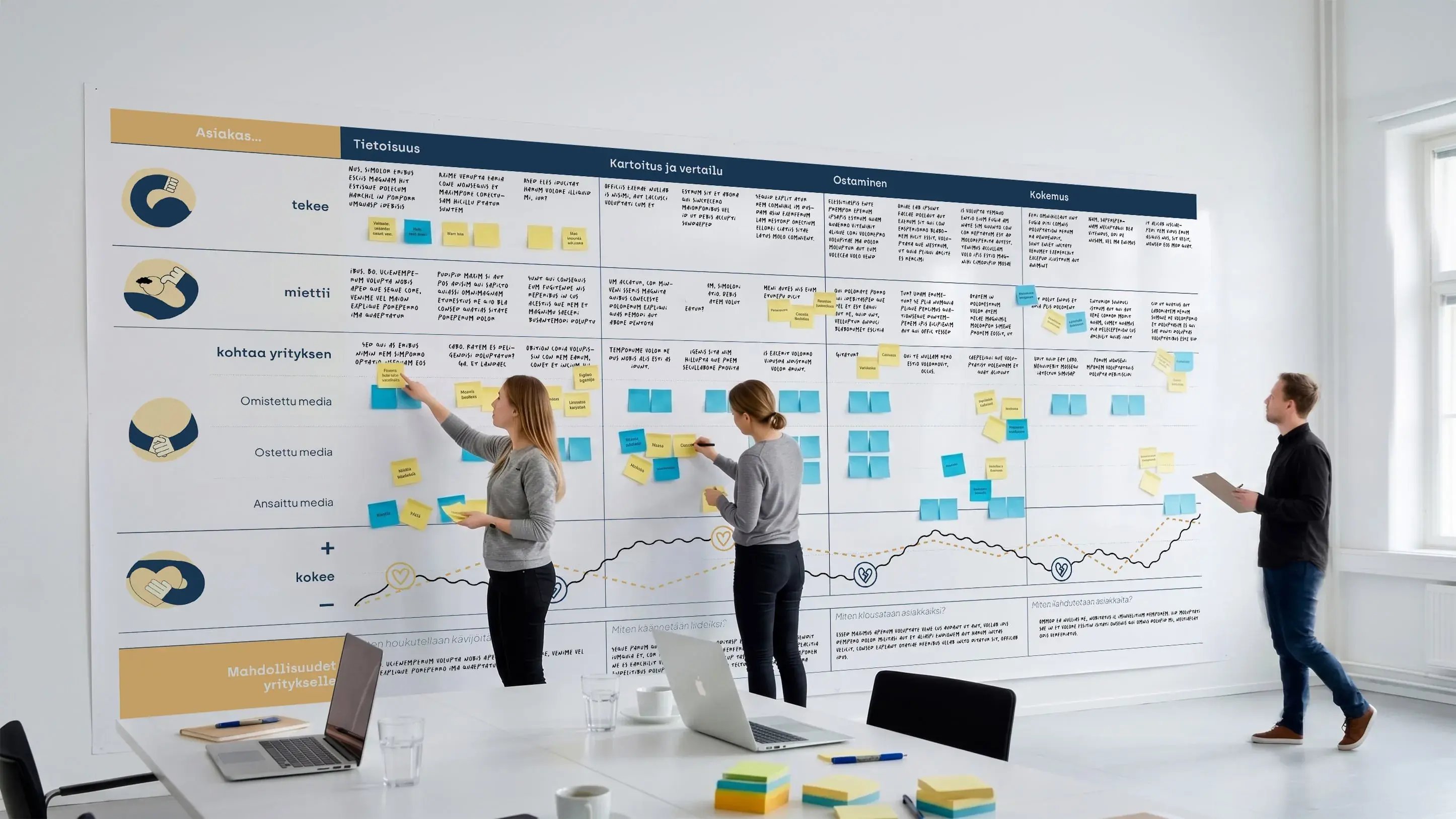
  2. Comprehensive buyer persona and buyer journey workshops

  3. Plan for systematising marketing and sales

The Playbook is an operating model built specifically for your company and its competitive situation, helping you ensure you reach your business goals. The Playbook concretely defines the key day-to-day practices and actions for marketing, sales, and customer service.

The Playbook is the foundation for building a sustainable growth story. It helps you escape the limbo of one-off quick fixes.

Get in touch. Let's build a professional model for your business that improves your chances of succeeding in an increasingly competitive market!

What Is a Marketing and Sales Playbook?

The Playbook defines all the key touchpoints between the company and its buyer personas – both existing ones and those in need of development – whether they occur in marketing, sales, or customer service. The Playbook also defines the main lines of the required content strategy and a view on budgeting.

At the heart of everything is the buyer journey, which progresses from the buyer persona's perspective through the awareness stage to the consideration and comparison stage, and further to purchase and customer experience.

The Playbook takes a stance on how the right buyer personas can be reached most effectively and how they are then converted into leads.

Once the leads are captured, they need to be warmed up and nurtured all the way to deals. And once the sale is made, the marketer must be able to build rewarding and distinctive customer experiences, thereby building customer loyalty. The Playbook creates a functioning cycle in which a loyal and satisfied customer makes more purchases and becomes an advocate by recommending the company to their acquaintances.

The aim is to brainstorm and identify all possible ways to increase the likelihood that a buyer persona progresses through the entire journey and doesn't jump ship to a competitor.

Playbook work also encourages thinking outside the box. When it comes to the end result, it doesn't matter whether the ideas and development opportunities identified relate to marketing, sales, product or service design, pricing, leveraging AI, or even product expansion. The main thing is that the likelihood of the company's key buyer personas making a purchase – and becoming loyal customers – improves.

What does the Playbook cost?

Use the price calculator to see what building the Playbook costs. The price depends on the current state of your company's marketing and sales foundations.

What Do You Gain from Defining a Playbook?

As the ancient master strategist Sun Tzu once said: "Strategy without tactics is the slowest route to victory, and tactics without strategy is the noise before defeat."

The Playbook bridges the strategic level and practical tactics. With the Playbook, you will:

  • Know your company's key buyer personas in greater depth
  • Identify the most important touchpoints between your company and its most potential customers
  • Know the most effective ways to generate leads
  • Know how to nurture leads into deals and deals into repeat customers
  • Know what kinds of AI agents you can use to enhance, refine, and improve the buyer journey
  • Find out where your company is losing customers to competitors
  • You will obtain a set of metrics to support management in achieving your goals

Blink's Playbook also includes a 12-month action plan, a content and channel strategy, and a view on the required budget.

Example:

AI Agents as Part of the Playbook

The benefits of AI are now available at an increasingly low threshold. HubSpot offers versatile AI functionality directly within its platform, making it especially easy to leverage for those whose marketing, sales, or customer relationship activities already run in the same place. Alternatives are of course available too – Claude, Gemini, and ChatGPT, for example, offer tremendous opportunities for simplifying everyday work.

Here are examples of how HubSpot's agents and assistants can be integrated into the Playbook:

Attract

  • Demand Agent: Defines the ideal customer profile (ICP) and searches for new companies that match it. Enriches contact information with data from various sources.

  • Inbound Agent: An autonomous chatbot on the website that assesses visitor interest, answers even complex questions, identifies likely purchase intent, books meetings, and closes (straightforward) deals without assistance.

  • AEO Agent: An easy-to-use tool that makes it simple to improve your chances of appearing in the responses of AI tools like Claude, Gemini, and ChatGPT.

Convert

  • Prospecting Agent: A proactive agent that monitors customer intent signals (internal signals such as opened emails or site visits, as well as external signals such as company announcements related to acquisitions), builds (and where needed, autonomously sends) cleverly tailored multi-channel message sequences, and creates tasks for customer service agents.

  • Guided Sales Assistant: A tool that converses with the salesperson and provides information on, for example, risks related to a deal, reminds them of similar past cases, and suggests effective practices that have previously helped win deals.

Delight

  • Customer Success Assistant: Prioritises and identifies the customers with the most urgent needs, creates ready-made message sequences, and highlights upselling opportunities.

  • Customer Agent: Responds to customer questions and resolves issues without delay, around the clock and every day. A large share of customer questions tend to be of a similar type, which means an AI agent can handle them even better than a human. A good example is a technical product information query – an AI agent has far greater capacity to pull the relevant information from technical product documentation.

How Is the Playbook Created?

The four-phase Playbook is implemented as a series of workshop sessions. Content is tailored to each company and its specific needs. Sometimes the focus is on developing marketing and sales, and at other times on defining how AI Agents will be leveraged.

The core elements of the Playbook:

1 Defining Buyer Personas

A buyer persona is a description of your company's ideal customer. There are typically 3–4 different buyer personas that are important to the business. Buyer persona definitions take a practical approach to the purchasing drivers and obstacles that affect the likelihood of closing deals. When we know the reasons behind a buyer persona's decisions and the criteria they use to weigh their choices, it becomes clearer which types of personas are potential customers and which are not. It is essential to uncover a clear view of the thoughts, goals, wishes, and obstacles that influence purchasing – otherwise we cannot know who we are selling to or how.

2 Mapping the Buyer Journey

The buyer journey describes the buyer persona's path from prospect to lead, from lead to deal, and from deal to a loyal customer relationship. A buyer journey is mapped for each persona defined in the previous phase. It concretely describes what the customer thinks, experiences, and does at each stage of the buyer journey, and in which channels the buyer persona is encountered – both by your company and by competitors.

The most important part of the buyer journey mapping is identifying the opportunities to influence the persona's progression through your pipeline rather than a competitor's. These opportunities may relate to developing communications, marketing, sales actions, leveraging AI and agents, or even service design.

Without defining the buyer journeys, it is difficult to create a shared view of how purchasing likelihood can be influenced.

3 Goals and Metrics

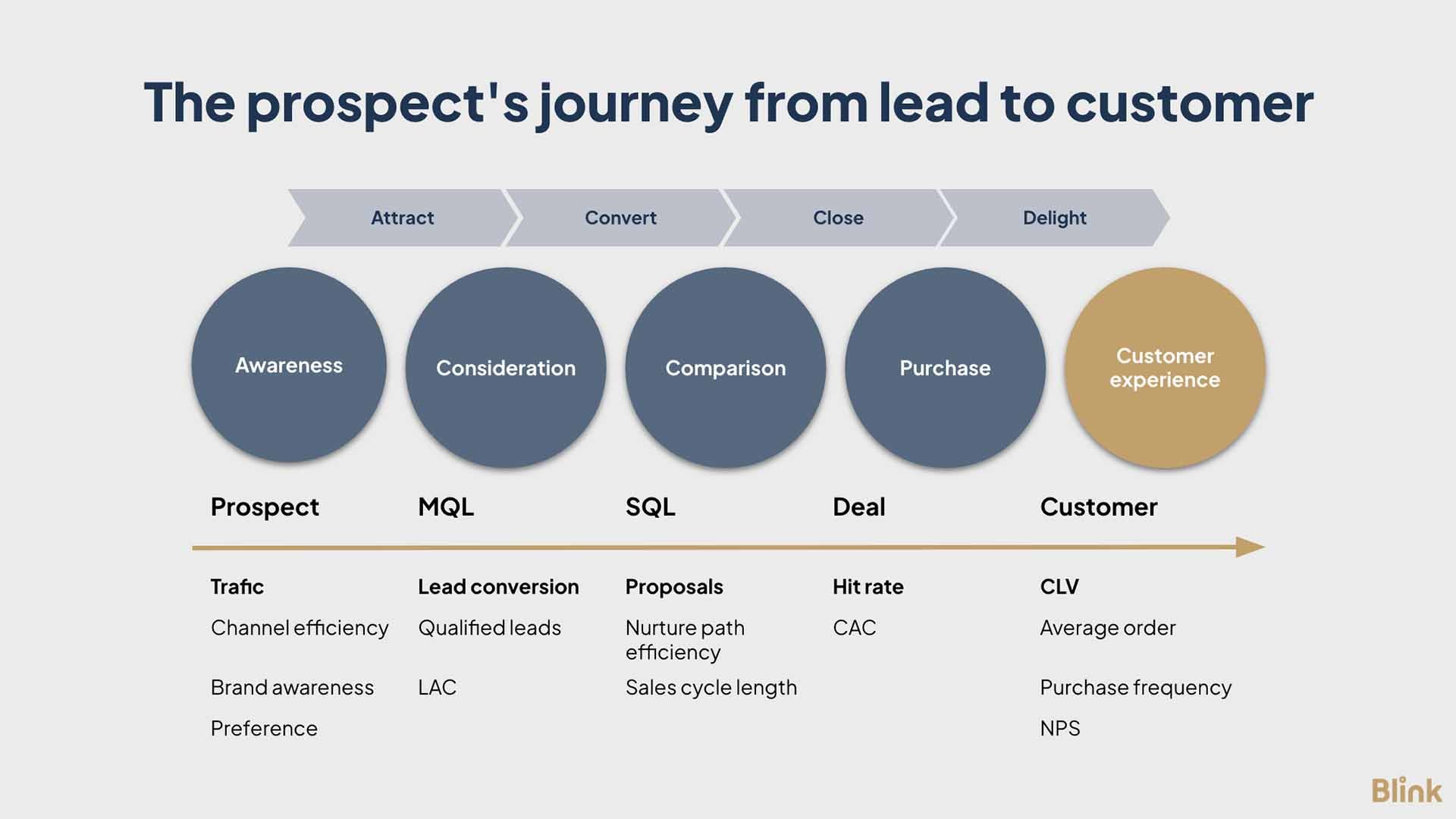
An effective Playbook requires clear goals to function. In the Goals and Metrics workshop, the current state of the most important key figures is reviewed, goals are set for improving them, and ways to measure progress are defined.
The image below shows examples of variables that are typically measured at different stages of the buyer journey.

4 Playbook Content

Finally, we create a company-specific, tailored Playbook based on the results of the workshops – one that ties together the big picture at the strategic level and the practical tactics of everyday work. The Playbook enables the strategy to be put into practice in day-to-day activities and routines.

The Playbook makes the systematic approach to marketing, sales, and customer experience concrete. The company's different functions – such as marketing or sales – receive clear guidance on how the company operates and by what means it intends to succeed in competition.

The Playbook can include the following elements:

  • Content strategy: what and how we communicate in order to outperform competitors
  • Channel strategy: where we meet our audience, so we are in the right place at the right time
  • AI strategy: how AI supports the company's way of working and which AI tools should be integrated into routines
  • Marketing model: through what kind of funnel (or loop) and actions marketing produces the target number of leads for sales
  • Sales model: how sales operates in day-to-day practice so that combined efforts accumulate into overall results
  • Customer service model: how to delight customers and improve the likelihood of repeat and additional purchases
  • Marketing budget: what kind of investment the Playbook requires
You get what you measure

The Playbook can also be built for an individual project

The marketing and sales Playbook is typically built as an operating model for the entire company. However, it can also be applied to a single separate project or even the piloting of a new business venture.
Is your marketing lacking direction?

Contact us or book a time in my calendar!

Antti Tolonen Managing Director antti@blinkhelsinki.fi +358 50 348 0347