Defining Buyer Journeys Is Part of Your Marketing Strategy
What is a buyer journey, and why does mapping buyer journeys matter in marketing? Divided into four key stages, buyer journeys help companies understand how to engage buyer personas at every step of the purchase process. It's worth defining your buyer journeys with expert support – explore Blink's buyer journey workshop!
Buyer Journeys at a Glance
-
Buyer journeys map the customer's path from the start of the purchase process all the way to an ongoing customer relationship
-
Buyer journeys help improve customer experience and make marketing more effective
-
Buyer journeys complement buyer persona descriptions
Defining buyer journeys helps a company understand how customers move through the purchase process from start to finish. When you know your buyer journeys, you market more effectively at every stage and provide customers with a better experience.
Buyer journeys also help a company understand its customers more deeply, respond to their needs at every stage of the buying process, and grow their interest in the company's brand and products.
What is a Buyer Journey?
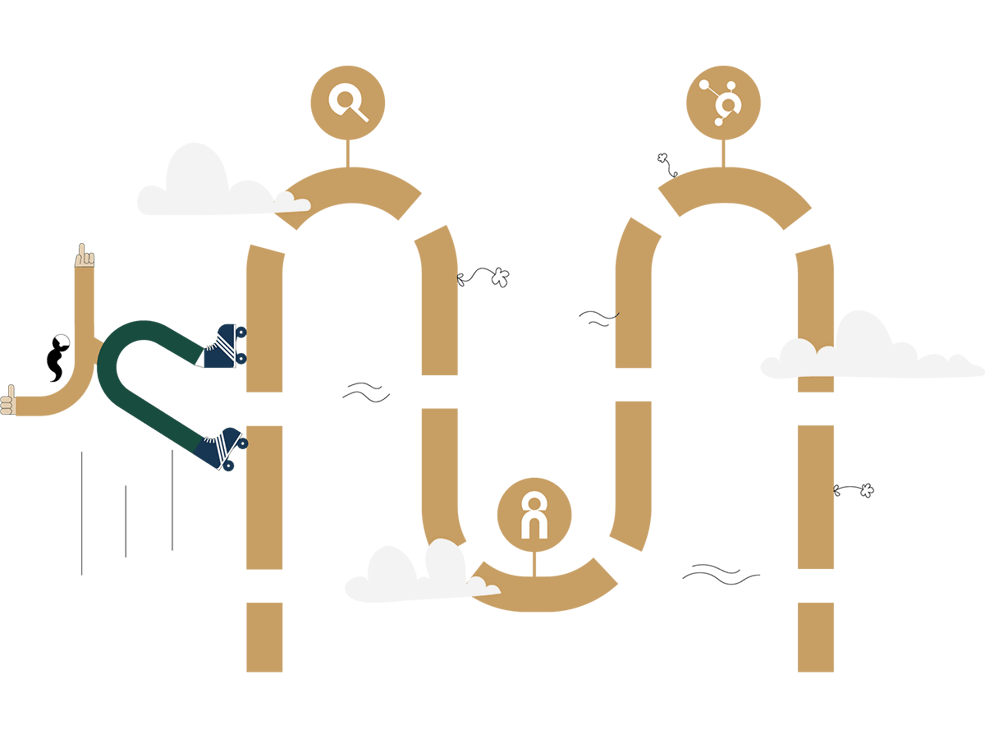
A buyer journey (customer journey) is the path a buyer persona travels from prospect to lead, from lead to deal, and from deal to a loyal customer relationship. Defining the buyer journey clarifies what the company does – and what it could do – across different channels to advance sales and nurture customer relationships.
The buyer journey is divided into four main stages of the purchase process:
- Attract
- Convert
- Close
- Delight
In the Attract stage, potential prospects are identified from the marketing target audience. In the Convert stage, these prospects are converted into leads. In the Close stage, leads are nurtured (warmed up) into deals, and in the Delight stage, customers are taken care of so that the customer relationship continues as fruitfully as possible.
How is a Buyer Journey Defined?
How is a buyer persona's journey actually defined? For each stage of the buyer journey, you need to find out what the buyer persona does and thinks while searching for, comparing, and purchasing a particular product or service.
You also need to identify all the channels and touchpoints where the buyer persona encounters the company offering the service. Channels can be owned (company website, social media channels, premises), paid (paid advertising and marketing), or earned (PR coverage).
The customer experience can be positive or negative at any stage of the buyer journey. A customer's expectations may, for example, be high at the start of the journey but fall below expectations as the purchase process progresses.
What are the Benefits of Defining a Buyer Journey?
-
You create a unified understanding within the company of how sales are generated.
-
You market more effectively at every stage of the buyer journey.
-
You grow sales through relevant offers and upselling.
-
You improve customer experience by understanding the path the customer travels.
-
You stand out from competitors by understanding customer needs better.
What's essential is understanding how customers think at different stages of the buyer journey. Knowing where and how customers look for solutions, and which channels they trust, is key.
The buyer journey covers the entire path from the moment a need arises all the way through the purchase and beyond.
Buyer Journey Workshop
Companies rarely, if ever, have a unified view of how their customers' buyer journey unfolds and where its strengths and weaknesses lie. In addition to differences of opinion, this is often due to varying perspectives. The marketing team working at the top of the funnel has a different view of the work than those in service delivery or sales.
Buyer journeys are easy to define with the right tools. Blink Helsinki uses a collaborative buyer journey workshop conducted together with different stakeholders from across the company.
What Does Blink's Buyer Journey Workshop Include?
The expert workshop is an agile way to build a baseline understanding of the buyer journeys of your most important buyer personas. The workshop typically brings in perspectives from different stages of customer interaction: marketing, sales, customer service, service delivery, and after-sales.
In the workshop, the following elements are mapped for the buyer persona across every stage of the buyer journey:
- Actions
- Thoughts
- Touchpoints (owned, paid, and earned media)
- Customer experience
- Development opportunities
Definitions are always made from the customer's perspective. This ensures that the activations and content for each stage of the buyer journey can be built to truly support the customer's path.
If the understanding of the different stages of the buyer journey is not consistent within the company, efforts easily fragment into disconnected messages that don't form a coherent whole. Buyer journeys should therefore always be defined – especially in connection with developing buyer personas.
How can Buyer Journeys be Enriched?
Just like buyer personas, buyer journeys can also be enriched by researching real customers. Workshop findings are supplemented by studying real prospects, leads, and customers. Methods that can be used for this include:
- Focus groups
- Interviews
- Participatory observation
- Cultural probes
Enrichment is a qualitative phase in which the research sample is typically quite small. This allows for intensive focus on individual people. On the other hand, because the sample can be small, it may not always represent the broader group. For this reason, verification and refinement – i.e. validation – is needed.
Validation can be carried out through various surveys, for example. In some cases, it may be necessary to make the survey a recurring, automated care model.
Buyer Journey Mapping in B2B and B2C Marketing
Mapping the buyer journey is important so that a company can identify opportunities to improve and develop how it meets and serves customers throughout the entire journey. In Blink's buyer journey workshop, the company's development ideas are collected in one place and integrated into the buyer journey model. The workshop model is particularly well suited to companies whose products require consideration and comparison.
This applies especially to large consumer purchases, as well as to almost all B2B companies. In-depth buyer journey mapping brings the least benefit to low-involvement impulse purchases where the financial investment is small. Buying a chocolate bar, for example, doesn't require the same level of consideration or comparison as purchasing a holiday, a car, a home, or almost any B2B service.
Buyer Personas, Goals, and Metrics Along the Buyer Journey
Buyer journeys are best defined in support of buyer personas. Buyer personas tell you who your ideal customers are. Buyer journeys reveal how those personas travel from prospects to leads, from leads to deals, and onward to loyal customer relationships. Without buyer journeys, it's difficult to know how customer acquisition actually works in practice. In addition to buyer personas and buyer journeys, it's also worth defining the related goals and metrics.
Interested in defining buyer personas and buyer journeys? We create a marketing success plan for your company using our four-stage Gameplan. Gameplan is carried out over several workshop sessions, and always includes the definition of buyer personas and buyer journeys, as well as brand goals and various metrics.
Explore Our Other Growth Marketing Services!
-
Buyer personas
With buyer personas, you know your customers better, know who you are marketing to and why, influence your target audience and drive real sales results. -
Success plan
A success plan is a marketing and sales plan based on your business growth strategy that will help you achieve your goals. -
Content strategy
A marketing content strategy is a plan for how a company will create, publish and distribute content. -
Inbound marketing
With inbound marketing, you build a data-driven marketing model for your business that brings potential customers to your website, converts visitor traffic into leads, nurtures leads into sales, and nurtures deals into loyal customers. -
Key metrics and key analytics
With the right metrics, your company can monitor the effectiveness of your marketing and make the necessary changes.