Search Engine Optimisation (SEO & GEO / AI Optimisation)
Your customers are searching for solutions on search engines right now. If your business doesn't rank at the top of search results or appear in AI-generated answers for the right queries, you're losing potential customers to your competitors. Traditional SEO alone is no longer enough. By combining SEO and GEO (AI optimisation), you ensure your content reaches your target audience – wherever they're searching.
Blink's Search Engine Optimisation in a Nutshell
-
Search engine optimisation ensures your customers find your content when they're looking for your services. It encompasses traditional SEO (visibility on Google), AI optimisation or GEO (visibility in AI-generated responses), and technical optimisation.
-
The vast majority of people never scroll past Google's first page – and a growing number go straight to AI for answers. If your content is not showing up in the top results or AI recommendations, it simply won't be found.
-
We make your content discoverable. We start by analysing your current situation and your competitors. From there, we build a strategy, optimise the technical foundations, create content, and ensure your visibility is tracked and measured.
What is Search Engine Optimisation?
Search engine optimisation means ensuring your content appears in the right searches across search engines and AI platforms. Optimised content ranks at or near the top – not buried on page five. SEO is constantly evolving. Google remains the most important search engine, and organic visibility on Google is achieved through SEO. But customers today also use other search platforms, including AI tools and voice search – and these require their own distinct approach to optimisation.
EO, GEO, AEO and AIO – what's the difference?
A beloved child has many names – and so does optimisation. Content can be optimised for different purposes. Here are the most common search optimisation terms worth knowing:
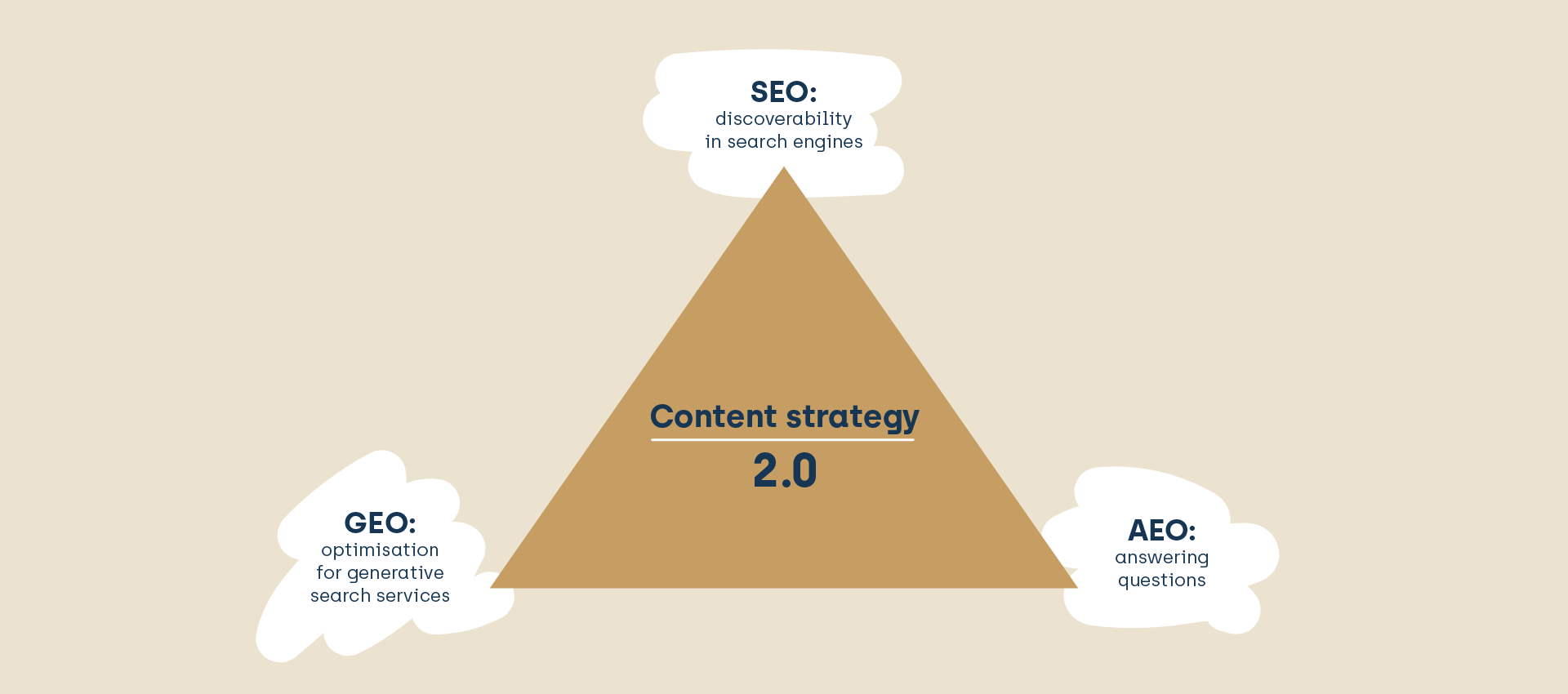
SEO (Search Engine Optimisation) is traditional search engine optimisation. It ensures your content appears among the top results in Google search. SEO focuses on keywords and building authority.
GEO (Generative Engine Optimisation) is AI optimisation. It ensures your content is mentioned when someone asks an AI tool for recommendations. GEO is the emerging umbrella term for all forms of AI optimisation.
AIO (Artificial Intelligence Optimisation) focuses on how AI systems read, understand, and score your content. It emphasises technical implementation.
AEO (Answer Engine Optimisation) means optimising content specifically around questions and answers.
Sound complicated? No need to worry. We make sure your customers find you – regardless of how they're searching.
Why is Search Engine Optimisation Vital for Your Business?
Everyone knows it. The vast majority of people never scroll past Google's first page. If your website doesn't surface for the right search, your content simply won't be found. Nearly all online experiences start with a search engine.
The majority of clicks from Google searches go to the top three results. The last position on the first page – tenth place – receives only a fraction of the attention. Without ranking near the top, you won't generate any meaningful organic traffic to your site.
People now use AI tools as search engines every day. If you're not appearing in AI responses, your organic visibility suffers.
Search Engine Optimisation is a Smart Investment
Traffic from paid advertising stops the moment you stop paying. Social media traffic is at the mercy of algorithms. SEO results, on the other hand, endure and compound over time. Once you reach the top of Google and appear in AI recommendations, you earn free, high-quality traffic year after year.
Five Signs Your Website Needs AI Optimisation Too
-
Your business doesn't appear in ChatGPT or Gemini responses when you ask for recommendations in your industry.
-
Your organic traffic has dropped significantly over the past year without a clear explanation.
-
Your content is written for keywords, not for questions and answers.
-
Your E-E-A-T signals are weak (experience, expertise, authority, trustworthiness).
-
Your voice search visibility is non-existent.
How We Handle Search Engine Optimisation
1. We analyse the starting point
First, we establish where you are and where you need to be. We use keyword research, competitor analysis, technical auditing, and AI visibility assessment.
2. We build a strategy that works
No shooting in the dark. We create a clear plan for your SEO. Not everything needs to be optimised at once – prioritisation is central here too. Every business and website is different. The strategy is tailored to your needs.
3. We audit the technical foundations
Google and AI tools can't find your content if the technical setup isn't working. We identify what's slowing your site down or getting in the way of mobile-friendliness.
4. We optimise existing content and create new content
Content is king – but only if it answers what customers are actually searching for. We optimise existing content and, where needed, create new content in the form of service pages, pillar pages, or FAQs.
7. We measure and optimise
SEO is never finished. Tracking its performance and making adjustments based on results is equally important. We monitor Google search rankings, site traffic, conversions, and AI visibility, among other metrics.
When Is the Right Time to Start Search Engine Optimisation?
The best time was yesterday – so the second best is today. You know you need SEO if:
- Your website receives too little organic traffic
- Your competitors appear in search results, but your business doesn't
- Paid advertising is driving all your traffic
- AI tools don't recognise your business
- Your content doesn't rank for important Google searches
Explore Our Other Creative Concept Services!
-
Brand & Identity
Building and maintaining a brand is an important part of a company's marketing and business growth strategy. -
Content Production
Content creation is an essential part of marketing and brand building. It provides valuable information to customers in different content formats. -
Digital Marketing
Digital marketing lets you reach your target audience cost-effectively through search engines, digital content and social media channels. -
Advertising and Marketing communications
Marketing communication is the way a company communicates its products or services to its target audiences in an effective way. -
Key Metrics & Key Analytics
With the right metrics, your company can monitor the effectiveness of your marketing and make the necessary changes.