Modern content optimisation is no longer just about keywords and fine-tuning metadata. AI-powered language models are growing increasingly capable of understanding the needs and motivations behind searches. As a result, search engines, generative search services and seamless user experience are becoming ever more intertwined.
Search engine optimisation is evolving rapidly. This article was first published in December 2024 under the title “How does SEO 2.0 affect content strategy and content?” and was updated with the help of AI in June 2026.Content Strategy 2.0 and Optimisation
SEO, AEO and GEO form a new trinity that strongly influences how content strategies are built.
- SEO ensures content is discoverable in traditional search engines
- AEO makes sure content answers users’ questions as directly as possible
- GEO optimises content for the ecosystem of generative search engines
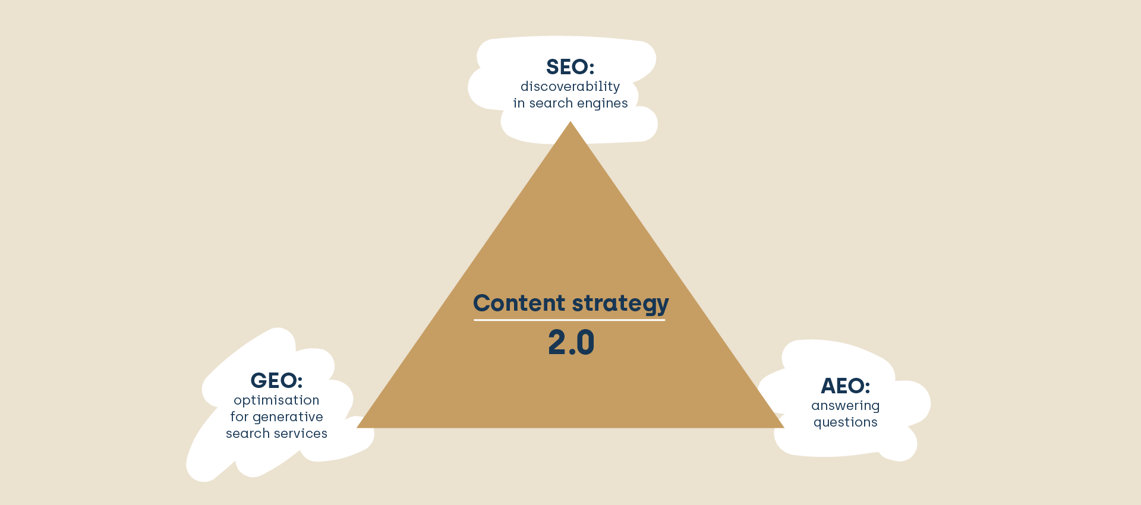
A successful content strategy serves all of these search services and places the user’s needs at the centre of everything. Content creators must develop a deeper understanding of their target audience’s motivations, needs and search intent – and know how to structure content so it serves both the information seeker and AI-based search services.
Searches are driven by different motivations
It’s worth creating content for your target audience’s different needs and different stages of the buying journey:
- Information need: the user is looking for information or guidance on a specific topic – provide a thorough answer that guides them on exactly this matter.
- Comparison: the user wants to compare options – provide a comprehensive and well-reasoned list of alternatives that makes it easy to choose.
- Purchase: the user is ready to buy a product or service – offer the smoothest and most enjoyable buying experience possible.

SEO – Content that’s found in search engines
As many as 88.1% of searches for which Google’s AI Overview generates a summary are informational in nature.
Search Engine Optimisation (SEO) focuses on how content and web pages appear as visibly and reliably as possible in search engine results (in Finland, primarily Google and Bing). Users search for information by typing, speaking or using images – and search engines favour content that meets their needs with high quality and proper technical optimisation.
SEO requires content and websites that:
- Are clearly structured and technically optimised
- Offer the user relevant and valuable information
- Build credibility and expertise
- Use diverse content formats such as text, images, audio and video
- Provide a good user experience: speed, accessibility and ease of use
AEO – Content that answers questions
Answer Engine Optimisation (AEO) focuses on how content answers users’ questions as clearly and knowledgeably as possible. Users are increasingly making searches using natural language, voice search and images. Algorithms surface content that can provide a fast, precise and reliable answer.
AEO makes use of content formats that:
- Answer questions directly and clearly
- Offer added value through deeper perspectives
- Leverage diverse content types such as text, images, audio and video
GEO – Content must be structured and relevant
Generative Engine Optimisation (GEO) aims to surface content in AI-powered generative search services such as ChatGPT, Perplexity or Google Gemini. In these services, the user receives an answer directly in conversational form.
GEO content therefore needs to be:
- Logically structured and easy for AI to utilise
- Credible, trustworthy and authoritative
- Designed so that generative models recognise it as a relevant source
Read also: How SEO is changing – and how to combine SEO and AIO (AEO & GEO)
User experience determines content success
SEO, AEO and GEO all emphasise user experience. An information search can be made by typing, speaking or using an image. A good user experience meets the searcher’s need: they expect to receive a fast, useful and contextually appropriate answer.
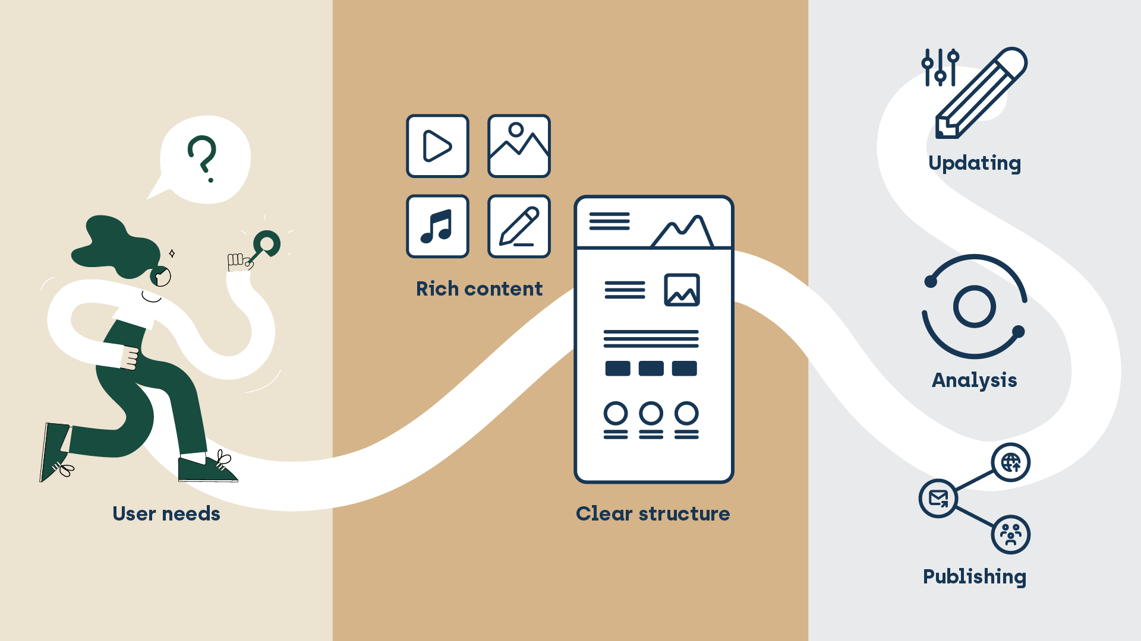
The focus of content strategy is shifting towards:
- Identifying and anticipating users’ questions and needs
- Enriched content (text, image, audio, video)
- Clear content structure and ease of use
Pillar pages and optimisation
A pillar page strategy and user-needs-optimised content production are not mutually exclusive. On the contrary: a well-structured pillar page offers a comprehensive overview of a topic and guides users to more in-depth related content.
From the perspective of SEO, AEO and GEO, pillar pages work as:
- SEO: broad authority content
- AEO: a structured information source that provides quickly discoverable answers
- GEO: a resource providing in-depth information that AI models can leverage
Practical tips for updating your content strategy
- Know your audience: use the buyer persona descriptions you’ve defined
- Stay up to date with search motivations: is this an information need, a comparison or a purchase?
- Invest in user-centricity: content must respond to a real need or question
- Optimise across channels: account for written searches, voice searches and visual searches
- Leverage AI: in keyword research, audience understanding, and content and format planning
- Monitor generative search services: test how your content appears in them and develop your content accordingly
Use HubSpot’s AI tools
If you use HubSpot, try out HubSpot's AI Search Grader and see at a glance how your brand messaging performs within its peer group. You’ll also receive tips for improving your content. Be sure to explore HubSpot’s other AI-powered features too!
Search engine optimisation is constantly evolving, but not everything needs to be overhauled. A pillar page strategy relevant to your target audience, a functional interface and the technical optimisation of your site remain important. The longer users stay on your pages, the more algorithms will favour your site – and all of these factors influence that.
When creating new content, update your knowledge of your target audience’s needs and motivations – these can change over time. Start by defining or updating your buyer personas. You can gather the information needed to build and update them directly from representatives of your target audience, from within your own organisation, from your website analytics – and of course from AI-powered search and content generation services.
Sources:
Semrush: AI overviews study
Passionfruit: SEO vs GEO vs AEO in 2025
Do you need a new content strategy?
Invest in content that matches your target audience's needs and search intent as closely as possible.