Skip navigation
Creative concepts

AI optimisation (GEO, AEO and AIO)

Luovat_konseptit_alasivu

What is AI optimisation and why does it matter?

AI optimisation helps your company's content and brand get found in AI services such as ChatGPT, Gemini, Claude, Perplexity and Google's AI Overviews. When your content is well optimised, AI trusts it and includes it in its answers. This kind of optimisation is often also called GEO or AEO.

AI optimisation matters because your customers are increasingly turning to AI for answers instead of search engines. If your brand doesn't come up in AI answers, you can easily lose the game before it has even started. Traditional SEO is no longer enough on its own. Make sure your company is visible to your target audience.
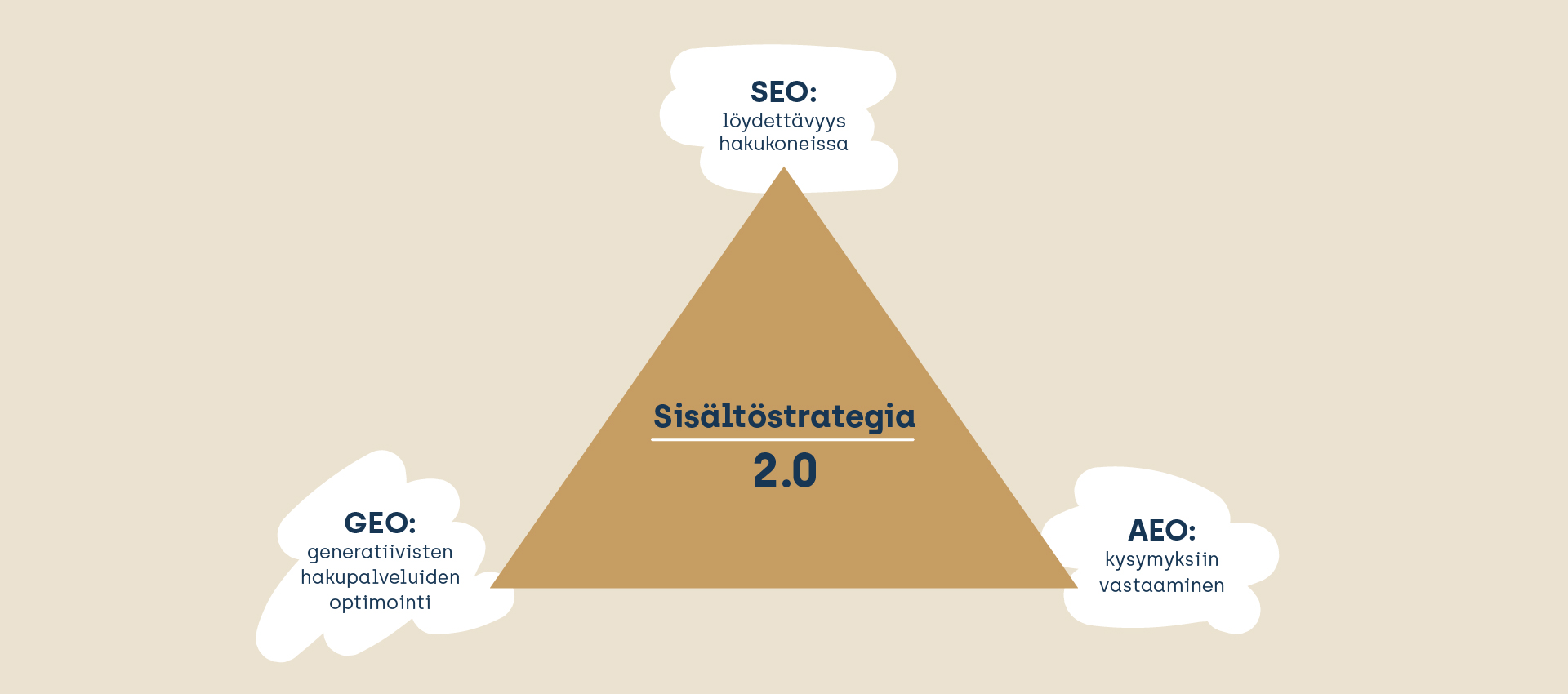
Sisältöstrategia 2.0

What does AI optimisation involve in practice?

AI optimisation is made up of several areas, delivered as one whole:

  1. Findability. AI can only find your content if your site is technically sound, gets indexed and lets AI bots read its pages.

  2. Content AI can quote. The point has to be made right at the top of the page, terms and product names need to be defined, claims need sources, and figures need to appear as text, not images. Above all, the content has to answer the questions buyers ask AI along their buying journey.

  3. Repetition, meaning the same message appearing in several places. AI trusts what it finds in more than one source, for example on your own site, your blog, LinkedIn and other people's publications. That's why we look at content from a distribution point of view as well as page by page.
  4. Ongoing monitoring of how your brand shows up in AI answers at different stages of the buying journey. We fix and create content based on what we find.

Blink's SEO and AI visibility audit

Make sure your site is optimised

For a fixed package price, we audit your site to see where its search engine optimisation and AI optimisation could be improved. Along with the analysis, you get our recommended actions.

Contact for more information

Quiz-BG

AI optimisation terms (GEO, AEO and AIO) in plain English

Popular things tend to pick up a lot of names, and AI optimisation is no exception. These are the most common terms worth remembering:

SEO (Search Engine Optimisation) is traditional search engine optimisation. It means optimising your site's content so it ranks in the traditional results of search engines such as Google. SEO is still the foundation of good AI optimisation, because many AI services search the web in real time.

GEO (Generative Engine Optimisation) is AI optimisation in the broader sense. GEO deals with three things: whether AI finds your company, whether it trusts it as a source and whether it mentions your company in its recommendations.

AEO (Answer Engine Optimisation), as the name suggests, focuses on optimising answers. It means optimising content so it works as a direct answer to the user's question. The term was in use before generative AI, for example in connection with Google's answer boxes and voice assistants.

AIO (Artificial Intelligence Optimisation) is, depending on who's using it, either a general term for AI optimisation or a description of its technical side. It focuses on how AI reads, interprets and evaluates your content.

LLMO (Large Language Model Optimisation) – this term describes optimising for large language models, the technology that ChatGPT, Gemini and Claude are built on.

AI Overviews and AI Mode give answers generated by Google's AI. AI Overviews appear above the organic search results, and AI Mode is the conversational search mode that opens from them.

Zero-click search is a search where the user gets the answer directly from the search engine or AI and doesn't click through to any website.

AI crawlers are bots AI services use to read websites, for example GPTBot (OpenAI), ClaudeBot (Anthropic) and PerplexityBot. If your site blocks them, even by accident, your content won't end up in AI answers.

Sound complicated? Don't worry. We make sure your customers find you, however they look for you.

GEO vs AEO: what's the difference?

In short, AEO optimises the answer to a question someone asks AI. GEO optimises your content and brand so that AI finds them.

AEO is always about the question and the answer. The goal is for a specific page or section of content to be chosen as the answer to a specific question. You can influence this with clear answers at the start of a page or section, question-style headings and FAQ content, definitions of terms and product names, and FAQ and Article markup.

GEO is about your brand and building trust with AI. The goal is for AI to recognise your company, consider it reliable and mention it when a customer asks for recommendations or compares options. You can influence this through repetition across different media, consistent company information, up-to-date content, references, customer stories and reviews.

You need both, because B2B buyers in particular look for both kinds of content along their buying journey. Early on, they're figuring out their problem and the terminology, and that's where AEO content shows off your expertise. Later, they compare suppliers and ask for recommendations, and that's where GEO decides the outcome: does AI trust your brand enough to recommend it?

Can AI optimisation decide the outcome before a prospect even gets in touch?

It certainly can. Your potential customers are getting answers to their questions from AI more and more often. When your pages are clear, properly structured and expert, they can make it into those answers and send demand straight to the right place.

The flip side is that clicks to your website will drop, if they haven't already. There's no point fighting that trend. The AI optimisation battle, on the other hand, is one you can win.

When your pages answer customers' questions, they support the buying decision and reduce uncertainty. This is especially important in B2B markets, where decisions are carefully considered and buying cycles are long.

Does your site need AI optimisation? Here's how to tell

  1. You can't find your company in AI answers (such as Google's AI Overviews, Gemini, Claude or ChatGPT) when you ask for recommendations in your industry.

  2. Organic traffic has dropped significantly over the past year for no clear reason.

  3. Your content is written for keywords, not for questions and answers.

  4. Your E-E-A-T signals (experience, expertise, authoritativeness, trustworthiness) are weak.

  5. AI mentions your competitors but not you, or it mentions your brand in the wrong light.

  6. Important information such as prices, technical specifications or comparisons sits on your site as images, PDFs or videos.
  7. You don't know whether AI bots can read your site.

This is how we work

Blink's SEO and AI optimisation audit

1. Analysing your starting point

We check whether AI is already bringing your company visibility and traffic. Using analytics tools (such as HubSpot AEO or SE Ranking), we look at AI-referred traffic and its conversions, branded search volume and how often AI mentions your company compared with competitors. We also map the competitors AI brings up. We document the baseline so later progress can be measured against it.

2. Carrying out a technical audit

We review at least eight different types of page, such as the home page, service pages, references and blog articles. We check whether AI crawlers can read the site, whether pages get indexed normally and whether the site has Schema.org markup. We also check whether AI can read information presented as images and video, and whether pages show an author, a date and definitions of key terms. You get a report on the site's technical condition and the fixes we recommend.

3. Testing whether your company appears in AI answers

Together, we choose 5–10 questions for each key topic area. They have to be questions your customers would actually ask. We run them in ChatGPT, Gemini, Perplexity, Google's AI answers or other agreed services, and record every mention of your company and any links to your site.

4. Prioritising recommendations

Based on our findings, you get a list of actions that will raise your company's visibility. They may cover content structure and missing topics, comparison and selection content, references and reviews, keeping company information up to date across different services, or technical fixes. We prioritise the recommendations by effort and impact.

5. Putting the recommendations into practice

We do what we recommend, in full or in part, on an agreed schedule. Quick fixes are worth doing straight away, while larger content projects are usually spread over a longer period. You have our copywriting, SEO, AEO and HubSpot specialists at your disposal.

6. Keep monitoring progress

We rerun the agreed questions regularly and compare the results with the baseline and the previous measurement. We report on our findings and suggest next steps based on them.

Depending on scope, it takes 1–3 weeks from kick-off to a finished report. After that, we implement the recommendations and monitor progress regularly for as long as you want to keep your visibility in AI answers up to date.

Frequently asked questions about AI optimisation

What does AI optimisation mean?

AI optimisation means improving your website, content and brand visibility so that AI services such as ChatGPT, Gemini, Claude, Perplexity and Google's AI Overviews find your company, trust it and mention it in their answers.

What's the difference between GEO and AEO?

AEO optimises content to work as a direct answer to a specific question. GEO determines whether AI recognises your brand, trusts it and recommends it.

Does AI optimisation replace SEO?

No. SEO is still the foundation of AI optimisation, because AI uses the same web pages as search engines.

Which AI services can visibility be measured in?

At the moment, visibility can mainly be measured in ChatGPT, Gemini, Perplexity and Google's AI answers. AI visibility measurement is developing all the time.

Is AI optimisation a good fit for B2B companies?

Particularly good. B2B buyers do extensive research before getting in touch, and more and more of them do that legwork with AI. AI optimisation makes sure your company is among the options in those searches.

Katso myös

  • Brand & Identity

    Brand & Identity

    Building and maintaining a brand is an important part of a company's marketing and business growth strategy. 
  • Digital Marketing

    Digital Marketing

    Digital marketing lets you reach your target audience cost-effectively through search engines, digital content and social media channels.
  • Content Production

    Content Production

    Content creation is an essential part of marketing and brand building. It provides valuable information to customers in different content formats.
  • Advertising & Marketing communications

    Advertising & Marketing communications

    Marketing communication is the way a company communicates its products or services to its target audiences in an effective way.
  • Key Metrics & Key Analytics

    Key Metrics & Key Analytics

    With the right metrics, your company can monitor the effectiveness of your marketing and make the necessary changes.
Start optimising now

Get in touch or book a time in my calendar!