The B2B buyer’s journey is not linear
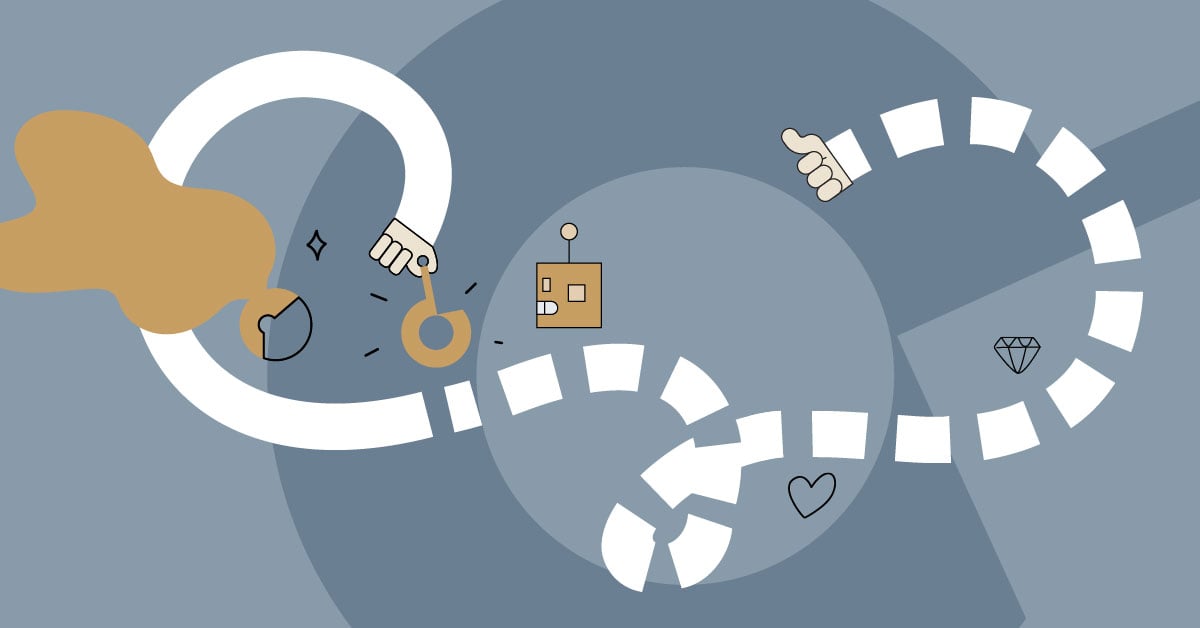
It is tempting to think of the buyer’s journey as a straight road along which the customer simply walks. In reality, the different stages of the journey can blend into one another, the path can be travelled back and forth, and entire sections may be skipped altogether. Yet every stage of the journey deserves attention, so that the overall experience meets the needs of every customer.
And as the B2B customer’s journey becomes ever more complex, information along the way is increasingly sought from multiple different channels before a purchasing decision is made.
That is why every stage of the buyer’s journey needs relevant content across different channels – this is key to attracting, engaging and converting customers.
Content types for each stage of the B2B buyer’s journey
How do you know which stages and content types to prioritise? A carefully crafted content strategy makes planning and execution much easier. It identifies the content types and channels that are most useful for the company’s ideal customer, and uses these to plan content for exactly the right stages of the buyer’s journey.
The stages of the buyer’s journey typically include awareness, consideration, comparison, purchase and customer experience. While each of these stages is unique, they can broadly be grouped into three phases:
- Top of funnel (TOFU – awareness and consideration)
- Middle of funnel (MOFU – evaluation and comparison)
- Bottom of funnel (BOFU – decision and purchase)
Let’s go through each of these in more detail.
1 TOFU – Content types for the top of the funnel
The goal at the top of the funnel is to reach a broad audience and spark interest in your target group by offering them something of value. At this stage, content does not yet focus on sales messages.
At the top of the funnel, potential customers are seeking information and solutions to their problems, but are often not yet ready to buy. In terms of the traditional buyer’s journey, this phase covers in particular the awareness and consideration stages.
Effective content types for the top of the funnel include, for example:
- Insightful blog articles. Informative articles focused on timely topics easily capture attention. Content might centre on industry trends, challenges or the solutions being sought. Consider guest contributions too – an outside expert’s perspective adds real value.
- Visuals and infographics. Visual presentations that simplify complex topics always attract attention and communicate expertise.
- Short videos. Don’t underestimate the persuasive power of video. Fast, informative and easily digestible content is an excellent way to strengthen your brand at the top of the funnel.
- Organic social media posts. Sparking conversations and building brand awareness on social media requires consistent activity. You can also boost organic posts with a small budget – for example through LinkedIn Thought Leader Ads.
SEO tip!
At the top of the funnel, the aim is to attract a wide audience. Use question-based and longer-tail search terms in your content. Example: “How to choose the right CRM system?”
2 MOFU – Content types for the middle of the funnel
In the middle of the funnel, potential customers are already aware of their problem and are actively looking for a suitable solution. At this stage, you need to offer your audience deeper, more targeted content. The purpose is to help the customer compare their options and understand why your company’s solution meets their needs.
Effective content types for the middle of the funnel include, for example:
- Webinars and other events. In-depth presentations and discussions give your target audience the expertise they are looking for.
- Guides and how-tos. Practical, step-by-step guides both deliver the information the customer is seeking and tell them more about the solutions you offer.
- Educational blog articles. Longer written content is also useful in the middle of the funnel. Create articles with educational and instructive content that helps your audience better understand industry practices and challenges.
- Newsletters. Round up the latest news, publications and other topical items. A newsletter can be sent via email or, for example, through LinkedIn. Calibrate the frequency to your industry – it could be weekly, monthly, or even once a quarter.
SEO tip!
In search engines, focus on mid-level keywords that relate directly to your product and target audience. Example: “Best CRM solution for mid-sized companies”
3 BOFU – Content types for the bottom of the funnel
At the bottom of the funnel, potential customers are already close to a purchasing decision, and it is time to present the final arguments that will convince them to choose your company. At this stage, content should remove uncertainties and make the decision as easy as possible.
Effective content types for the bottom of the funnel include, for example:
- Free trials and demos. The opportunity to test a product before purchasing makes it easier to reach a final decision.
- Case studies and customer testimonials. Real feedback and customer stories about your company’s services build trust and provide reassurance for the final decision.
- Service descriptions and guides. Whether it’s a pricing page, a guide or even an ROI calculator, all the additional information you offer is crucial at the bottom of the funnel.
- Consultations. Personal conversations are also valuable content. Make it easy to get in touch – whether by chatbot, email or phone. Always offer a contact method that suits your target audience.
SEO tip!
At this stage, use conversion-focused keywords in your SEO. Examples: “Buy CRM solution”, “Book CRM solution demo”.
Which channels should a B2B company use to distribute content?
To ensure content reaches the right audience, distribution should leverage several different channels in addition to the company’s own website. Among social media platforms, LinkedIn is perhaps the most important channel for B2B marketers. Facebook and Instagram work best at the top of the funnel for building brand awareness, and later for retargeting campaigns.
TikTok is also growing in popularity for B2B marketing. Short videos can be expert and engaging despite their format. Read more about social media algorithms!
Email marketing remains one of the most effective channels for B2B lead nurturing and moving customers along the buyer’s journey. Personalisation and segmentation help target the right content to the right people, while automation ensures the right timing on your behalf. When email marketing is combined with other content channels, it supports the content strategy in a sustained and effective way.
Plan, execute and measure – get your content Strategy in shape
Success at the top of the funnel is measured primarily through visibility and engagement. In the middle of the funnel, the key is to track how many people in your audience continue to engage more deeply with your content – for example by downloading a guide or attending an event. At the bottom of the funnel, what matters is how effectively content guides customers towards a purchase decision, which can be measured by the number of quote requests and enquiries received.
Effective content marketing requires planning, the right channel choices and continuous optimisation. Fortunately, you don’t have to do it alone. We help your company build a functioning content strategy, create content that speaks to your target audience, and measure the concrete results it delivers.
👉 Get in touch and let’s explore how content marketing can support your company’s growth and sales!
Jonna Hietikko
A digital marketing specialist with a heart that beats for great content.