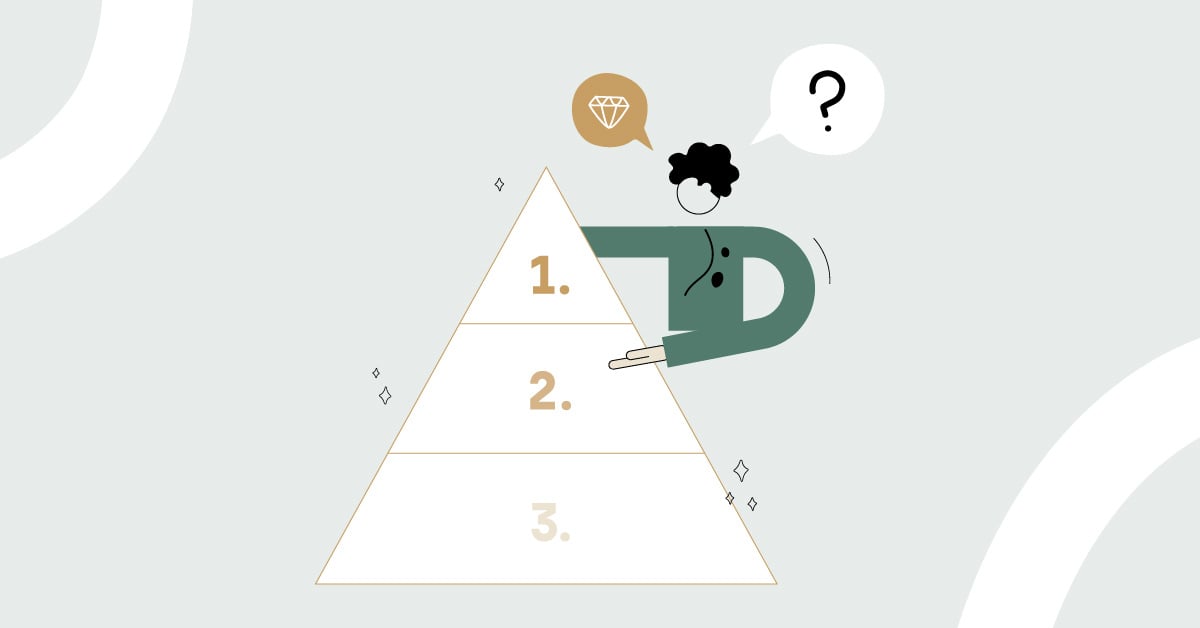
The goal of positioning is to ensure that your brand has a clear location in the mental map forming in the recipient's mind. A good positioning strategy takes into account the brand's strengths and weaknesses, customer needs, and competitors' marketing messages.
Thanks to successful positioning, you can direct recipients' attention to the areas where you can outshine your competitors.
Positioning is worth considering before most other brand development work. But as is so often the case in marketing strategy, positioning and branding are tightly intertwined – you can't have one without the other!
Here are a few dimensions you can use to define a winning position for your product:
Product features or customer benefits
In this positioning model, the focus is particularly on quality – durability, reliability, style, and so on. If we're talking about toothpaste, "fresh and reduces tartar" could be an example of feature- and benefit-based positioning. And a modern dyneema rope could be positioned as "stronger than steel" – positioning that still draws heavily on the product and the benefit it delivers.
Origin or method of production
Is the product domestic? Was it made or grown in a specific place or using a specific method? Emphasising origin can create a strong position, as can the production method: "this wool sweater was hand-knitted in Välkyä, Mälkimaa." Or "lamb raised in the wild mountains of New Zealand."
Pricing
Is the product or service expensive, affordable, or even cheap? The question can only be answered by examining the relationship between price and the value perceived by the customer. When a customer feels they are getting a lot of value relative to the price, it may feel affordable even if the monetary amount is significant – and vice versa.
For some target groups, extreme expensiveness can itself be an interesting position – "don't you have anything more expensive?" a luxury tourist might ask while shopping for souvenirs!
Intended use
Particularly in the context of product line extensions, positioning based on intended use is a practical approach. For example, if a tape manufacturer adds border tape alongside masking tape, the new product should be positioned as a home décor item rather than a renovation product. Or if a cold drink manufacturer decides to add hot drinks to its range, the new products will most likely find their position among winter rather than summer beverages.
Origin
Where does the product come from? Is it from the neighbouring farm or from New Zealand? Are both the design and production domestic?
What are the steps in positioning?
- Identify your target audience – know who you want to reach and who you want to influence.
- Define the value your customer perceives and your product's competitive advantage – invest in this, because without it, your positioning will be incomplete or even ineffective.
- Make sure your brand is in good shape. Otherwise your efforts won't produce maximum results.
- Define your position in the dimensions you've chosen and write a concise positioning statement. Remember to measure everything you do against your chosen position – do your actions reinforce it or not?
Timo Vennonen
Timo masters the strategic planning of marketing and communications from ideation to execution.